When AI Makes Information Easier to Use — But Harder to Trust
When AI Makes Information Easier to Use — But Harder to Trust
A narrow research question about whether AI transformation preserves the meaning a human decision still depends on.
AI can make large volumes of material easier to use.
It can shorten, sort, structure, and present information in a form that helps a person act.
That is real value.
But a transformed output can become easier to use at the same time that something important is silently lost.
The central problem is not only whether the output looks clear.
It is whether the meaning that still matters for human judgment has been preserved.
Transformation creates value — and risk
AI transformation can reduce volume and improve structure.
This helps a human reach the point of action faster.
But the same transformation may also remove, weaken, compress, or fail to carry forward something that later turns out to be significant.
That creates a practical governance problem:
How do we gain the value of transformation without quietly losing meaning the decision still depends on?
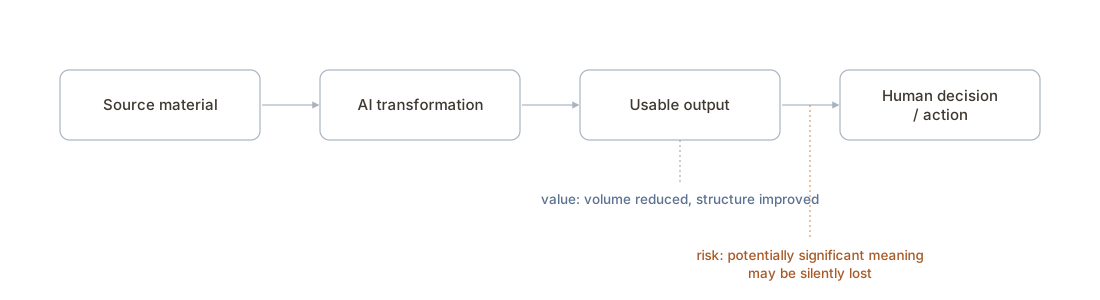
AI transformation can improve usability while still creating a risk of silent meaning loss.
The question is not only “Was the output useful?”
A more precise question is:
Can the original human intent and the preserved meaning be reconstructed from the output?
If the answer is no, then the transformation may have produced something convenient without remaining fully accountable to what it was supposed to carry forward.
This does not mean every output must reproduce the source in full.
It means the transformation should not sever the connection between:
- what the human needed,
- what the AI did,
- and what the output now actually supports.
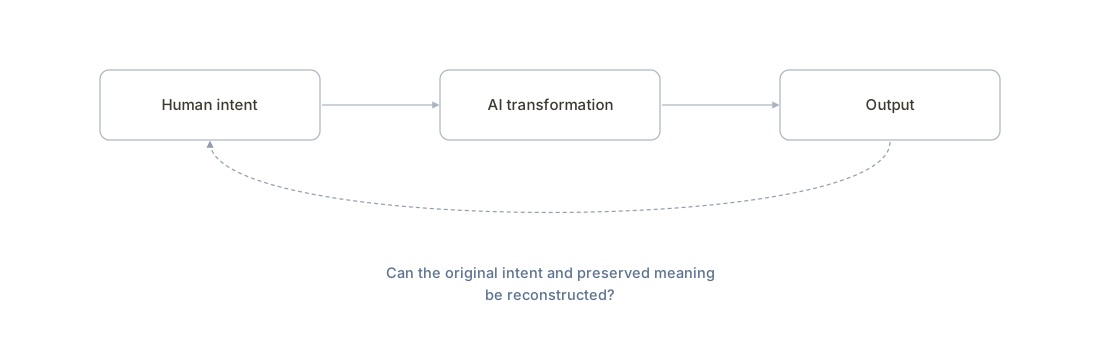
A useful transformation should still leave a reconstructable path back to human intent and preserved meaning.
False equivalences
In AI-supported work, several dangerous substitutions happen very easily:
- shorter is mistaken for sufficient
- cleaner is mistaken for complete
- confident is mistaken for safe
- structured is mistaken for faithful
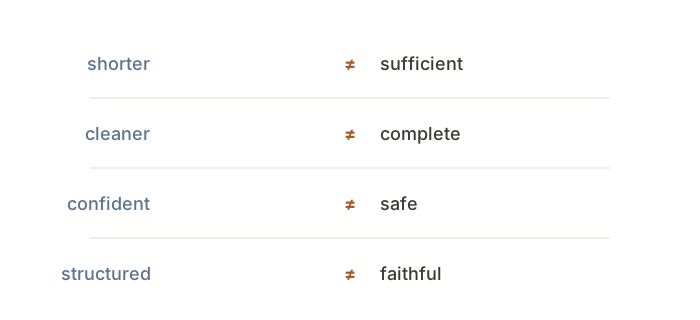
Improved form does not by itself prove preserved meaning.
These are not the same.
A polished output may still omit what matters.
A confident answer may still be wrong.
A well-structured summary may still fail to preserve the meaning the decision depended on.
Working research position
Our present working position is narrow.
We are not claiming that every AI transformation is unreliable.
We are not claiming that human decision-making should return to raw material only.
We are asking a more specific question:
What kind of check can test whether AI transformation preserved the meaning needed for responsible human use?
This points toward a possible research direction:
a meaning-preservation check — not as a replacement for human judgment, but as a control on transformations that sit between source material and action.
The working idea is that such a check would not replace functional safety, logging, Human Oversight, review, or execution controls. Instead, it would examine the transitions between them and ask whether what needed to remain invariant actually survived the transformation.
Possible invariants include:
- original human intent;
- authorised purpose;
- material constraints;
- conditions of applicability;
- uncertainty relevant to reliance;
- allowed consequences;
- review or STOP conditions;
- responsibility for the next transition.
The purpose is not literal textual identity.
The purpose is equivalence of decision-relevant meaning across transformation.
From preserving artifacts to preserving governing relationships
The research has now moved one step further.
Preserving source material, provenance, or even the exact original wording does not necessarily establish that the governing meaning survived.
A process may retain all of the relevant concepts while changing the relationship between them.
For example:
Evidence → supports → Claim
is not equivalent to allowing the claim to validate the evidence that was supposed to support it.
Observation → triggers → Reassessment
is not equivalent to allowing the observation itself to acquire decision authority.
Authority → permits → Action
is not equivalent to treating the resulting action as proof that the required authority existed.
The issue is therefore not only whether the nodes in a process remain visible.
The relationship between them may also matter: its direction, role, scope, and permitted consequence.
This suggests a narrower working question:
Can an AI-supported process preserve and inspect not only its artifacts and states, but also the governing relationships between them?
A related risk appears when epistemic states are silently strengthened.
For example:
UNKNOWNis not automaticallyNO;UNVERIFIEDis not automaticallySUPPORTED;OBSERVEDis not automaticallyMATERIALLY RELEVANT;MATERIALLY RELEVANTis not automaticallyAUTHORISED TO DECIDE.
A particularly important form is:
absence of evidence of change ≠ evidence of absence of change
The words are nearly the same, but the claims are not.
This page does not establish a new RABA principle or mechanism from these distinctions.
The current task is to pressure-test whether they are already handled sufficiently by existing requirements, assurance, provenance, safety, and governance approaches, or whether a narrower residual remains.
Why this matters
A human being usually reads text as if it carries intention.
Coherent language invites the reader to infer a source that understood, selected, and meant what was written.
With AI-generated or AI-transformed material, that inference can become misleading.
A human may encounter a clear, well-structured, confident output even though the relationship between that output and the original evidence, instruction, or intent is incomplete.
The more usable the output becomes, the easier it may be to rely on it.
That is exactly why preservation of meaning matters.
The problem is not only whether AI gives a wrong answer.
The problem is whether transformation produces something that looks decision-ready while hiding what may have been lost on the way.
From error to transition
This research direction emerged from a broader examination of confidently wrong AI outputs.
A working corpus of documented legal cases showed a recurring path:
machine-produced false or insufficient basis → professionally credible form → human control does not stop the error → the result enters a consequence-bearing process.
That corpus is useful for studying how error penetrates a decision process, but it does not by itself establish the earliest causal precursors in every domain.
This page therefore does not claim a universal failure mechanism.
Instead, it isolates a narrower transition question that can be tested against concrete cases in medicine, functional safety, industrial AI, Physical AI, and other consequence-bearing environments.
Current test direction
The next step is not to invent a new governance mechanism by default.
The next step is to test whether a meaning-preservation check can add value where strong existing controls are already present.
The research question is therefore:
When existing safety, oversight, logging, review, and execution processes are each locally correct, can a cross-transition meaning-preservation check help align them so that final system behaviour still reflects the authorised human intent and decision-relevant constraints?
A useful answer may be:
- existing methods already solve this sufficiently;
- the problem is real but better addressed by refinement of existing controls;
- a cross-transition check adds value;
- the hypothesis is wrong;
- or the evidence remains insufficient.
Any of those outcomes is acceptable.
The goal is not to manufacture differentiation.
The goal is to test whether a material residual problem remains.
Current status
This page does not present a finished mechanism.
It records a working research transition:
from general concern about AI error → to preservation of meaning → to reconstructability → to testing whether locally correct processes remain aligned across transitions.
Status: working research direction / non-canonical / public research note